LogoLogoLogoLogo
  • Home
  • About Us
    • Mission
    • Partners
    • Organization
    • Members
    • Officers
  • News
    • Focus Articles
    • Scientific Highlights
      • Scientific Highlights from Network Area 1
      • Scientific Highlights from Network Area 2
      • Scientific Highlights from Network Area 4
    • Meetings
    • Events
    • Job Opportunities
    • Newsletters
    • Picture Galleries
    • Brochures
  • Research Platforms
    • Synthesis
    • Experimental
    • Theory & Simulation
  • Network Areas
    • Network Area 1
    • Network Area 2
    • Network Area 4
  • Downloads
    • Brochures
    • Consortium Agreement
    • Newsletters
    • Logo
    • Research Road Map
  • Contact
  • User Area
✕

Scientific Highlights from Network Area 2

  • Home
  • News
  • Scientific Highlights
  • Scientific Highlights from Network Area 2
  • Filter by
  • Categories
  • Tags
  • Authors
  • Show all
  • All
  • Focus Articles
  • Scientific Highlights
  • Scientific Highlights from Network Area 1
  • Scientific Highlights from Network Area 2
  • Scientific Highlights from Network Area 4
  • Uncategorised
  • Webinars
  • All
  • 2019
  • 2025
  • 3D print
  • active particles
  • adhesion
  • AERC2018
  • Ancona
  • Annual Meeting
  • artificial cells
  • biopolymer gel
  • Bombannes
  • cell biology
  • colloids
  • compartmentalisation
  • condensates
  • conformational space
  • crystallization
  • DNA
  • doctoral programme
  • emulsions
  • failure
  • flow
  • fluidization
  • green chemistry
  • International Soft Matter Conference
  • ISMC
  • liquid repellence
  • Mestre
  • micelles
  • microfluidic chip
  • microfluidics
  • microrobots
  • microscopic dynamics
  • molearn
  • networks
  • phase separation
  • phase transition
  • PhD
  • polymers
  • proteins
  • Rheology
  • robotics
  • rods
  • rubber
  • self-assembly
  • semiconductors
  • Soft Matter
  • SoftComp
  • spectroscopy
  • spin diffusion
  • summer school
  • surfaces
  • sustainability
  • tear and wear
  • tube dilation
  • upcycling
  • water
  • All
  • Angela Wenzik
  • Flavio Carsughi
  • Com21 Com21Com21
18th October 2022
18th October 2022

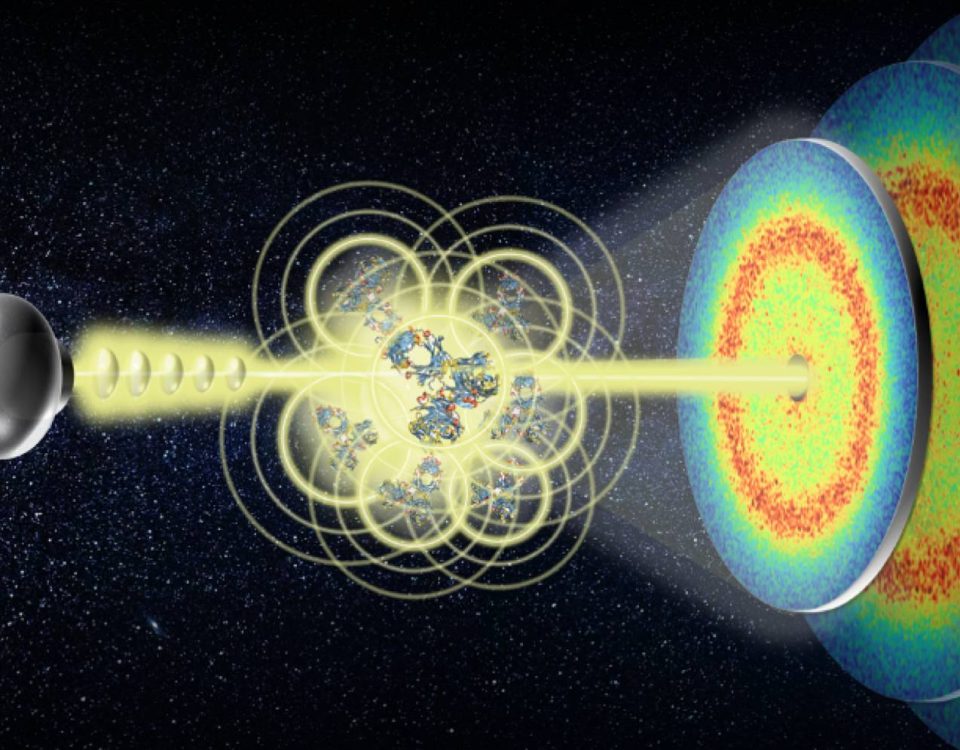
Investigating protein solution dynamics using XPCS at an XFEL

Novel experiment opens up possibility of studying collective dynamics providing insight for better drug... (Read more)
Do you like it?0
Read more
11th March 2022
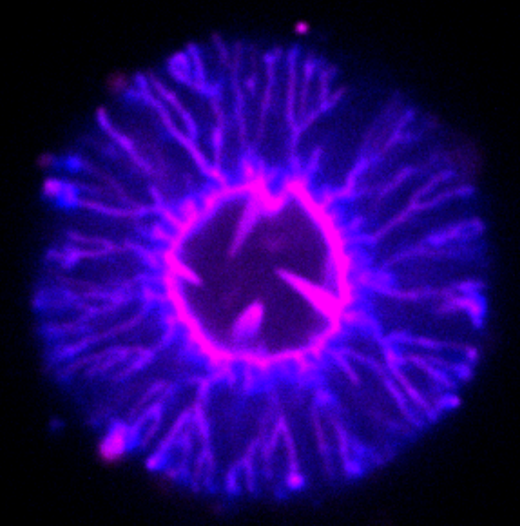
Figure 2: Membrane deformations induced by actin assembly. A membrane bilayer (pink) constituting an initially spherical liposome is deformed through the growth of a branched actin network (blue marks the colour of the end of actin filaments) at its surface. Spikes (inward) and tubes (outward) are formed during this process. Note that compared to the cell geometry, the geometry here is inside out, as the ingredients of the cytoskeleton are outside the liposome. Bar 5 μm. Copyright: Cécile Sykes, CNRS
11th March 2022

How Active Biopolymer Networks Shape the Cell Membrane

Experiments on active deformations of a cell membrane by an actin assembly may inspire new materials and approaches. Cécile Sykes from the Laboratoire de Physique de l‘Ecole Normale Supérieure reports on results raising... (Read more)
Do you like it?0
Read more
9th March 2022
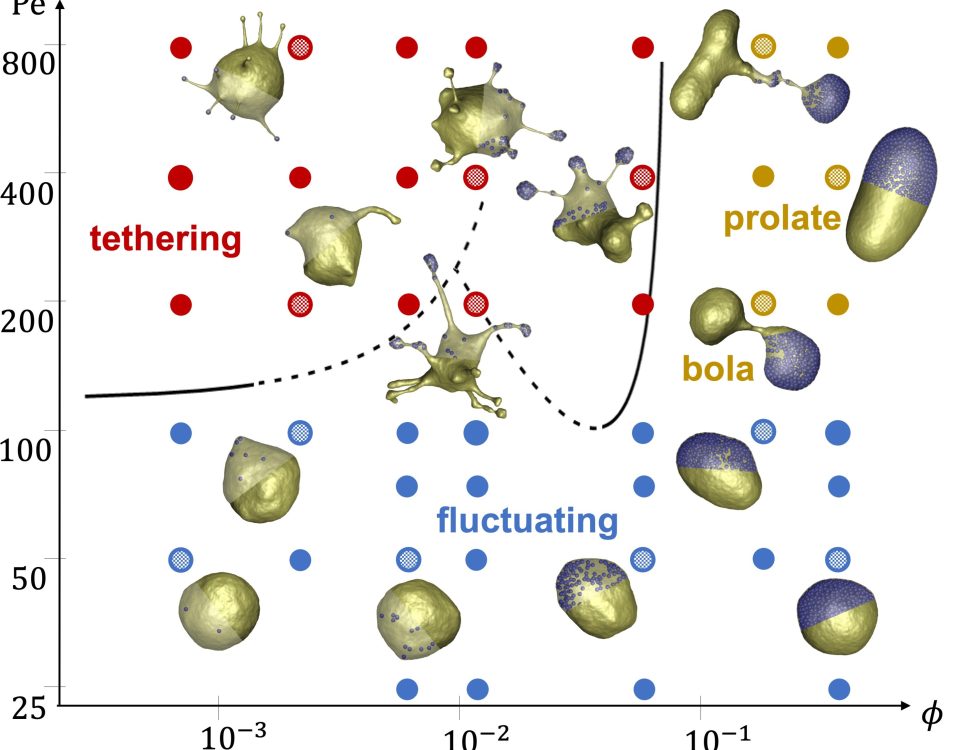
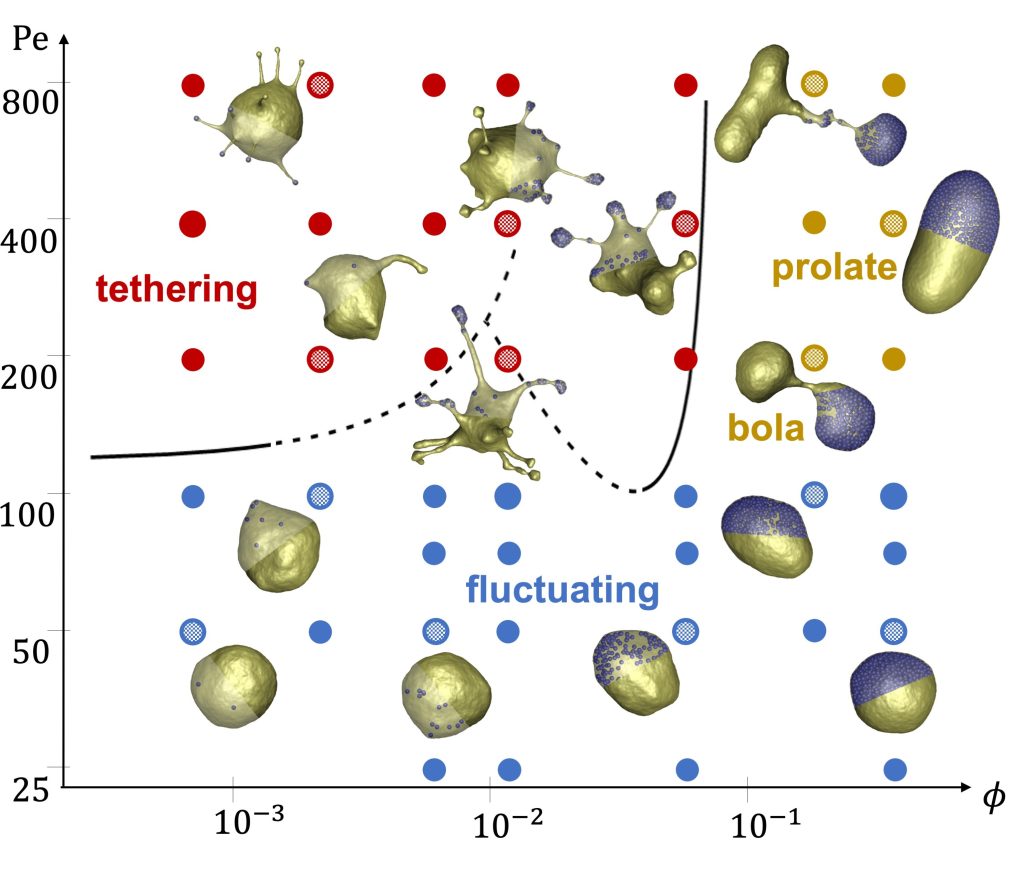
Figure 1: Simulated state diagram illustrating various membrane structures for different Peclet numbers (Pe) characterizing particle propulsion strength and volume fractions (ϕ) of active particles. The three main regimes are tethering (red symbols), fluctuating (blue symbols) and bola/prolate (brown symbols) vesicle shapes. Each dot containing a grid pattern indicates the position of the nearest snapshot within the shape diagram. Simulations mimic a nearly tensionless flaccid vesicle. Copyright: authors
9th March 2022

From Soft Active Systems to Synthetic Cells

Scientists from the ETH Zurich and Forschungszentrum Jülich highlight their recent collaborative study on a novel active system of self-propelled particles (SPPs) enclosed in a lipid vesicle, which exhibits dramatic shape changes resembling... (Read more)
Do you like it?0
Read more
8th March 2022
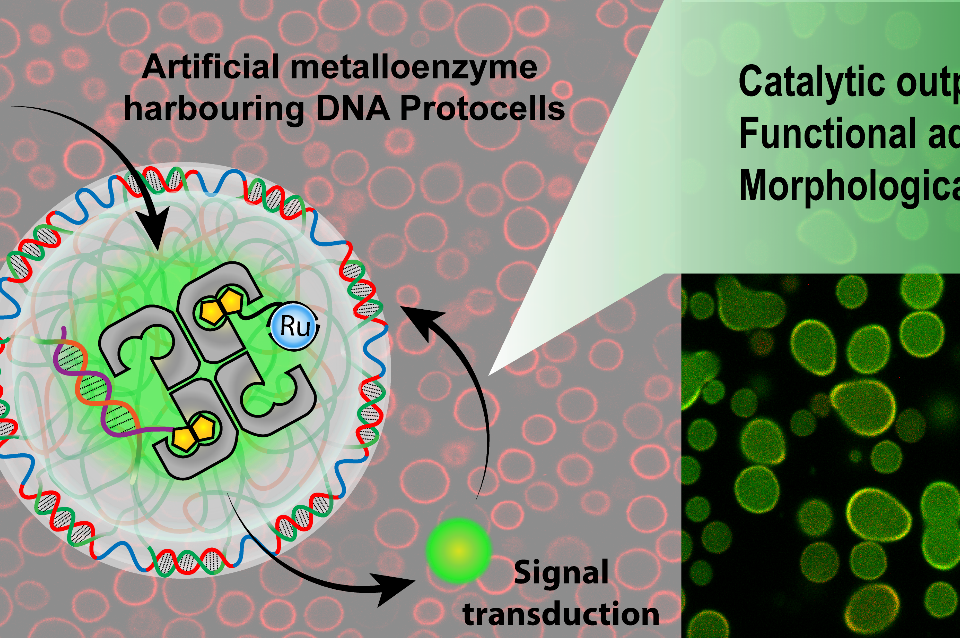
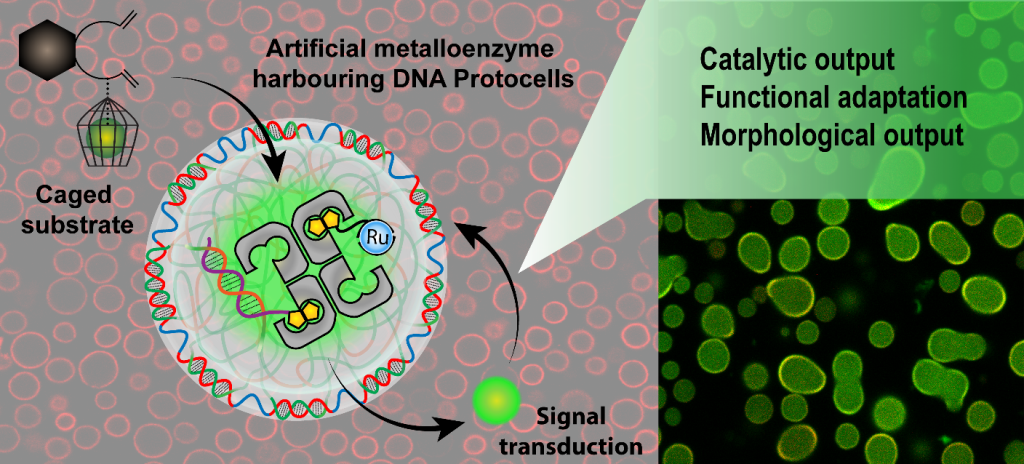
The new concept makes it possible to induce complex behaviour in adaptive and communicating soft matter microsystems. Copyright: Avik Samanta
8th March 2022

Towards the Minimalistic Design of Life-like Abiotic Systems

We unravelled polymer-like phase-separation behaviour in multiblock single-stranded DNA which provides an opportunity to fabricate all-DNA protocells with several encoded sequences for post-functionalization with spatio-temporal... (Read more)
Do you like it?0
Read more
Prev page
1234567
Next page
softcomp@fz-juelich.de | Imprint | Privacy Policy