
Biomolecular condensates formed by liquid-liquid phase separation (LLPS) of biopolymers are increasingly recognised as fundamental components in biological systems, not only for intracellular signaling and functions, but also for extracellular secretory fluids of living organisms. Adding to findings previously published by SoftComp (“Tricks from Ticks”), researchers from SoftComp partner Wageningen University & Research (WUR) in the Netherlands revealed how pH tunes the phase separation dynamics of a glycine-rich protein found in tick saliva and further dictates the material properties of the formed condensates. They further used this knowledge to investigate how pH influences the sequestration of curcumin in condensates which can be developed into a future condensate-based drug-delivery vehicle.
Tiny Defects, Big Consequences: Why Micron-thick Films Tear Before Molecular Forces Matter
22 May 2026
SoftComp/EUSMI Annual Meeting 2026 in Zakopane with more than 100 attendees
15 June 2026Tiny Defects, Big Consequences: Why Micron-thick Films Tear Before Molecular Forces Matter
22 May 2026SoftComp/EUSMI Annual Meeting 2026 in Zakopane with more than 100 attendees
15 June 2026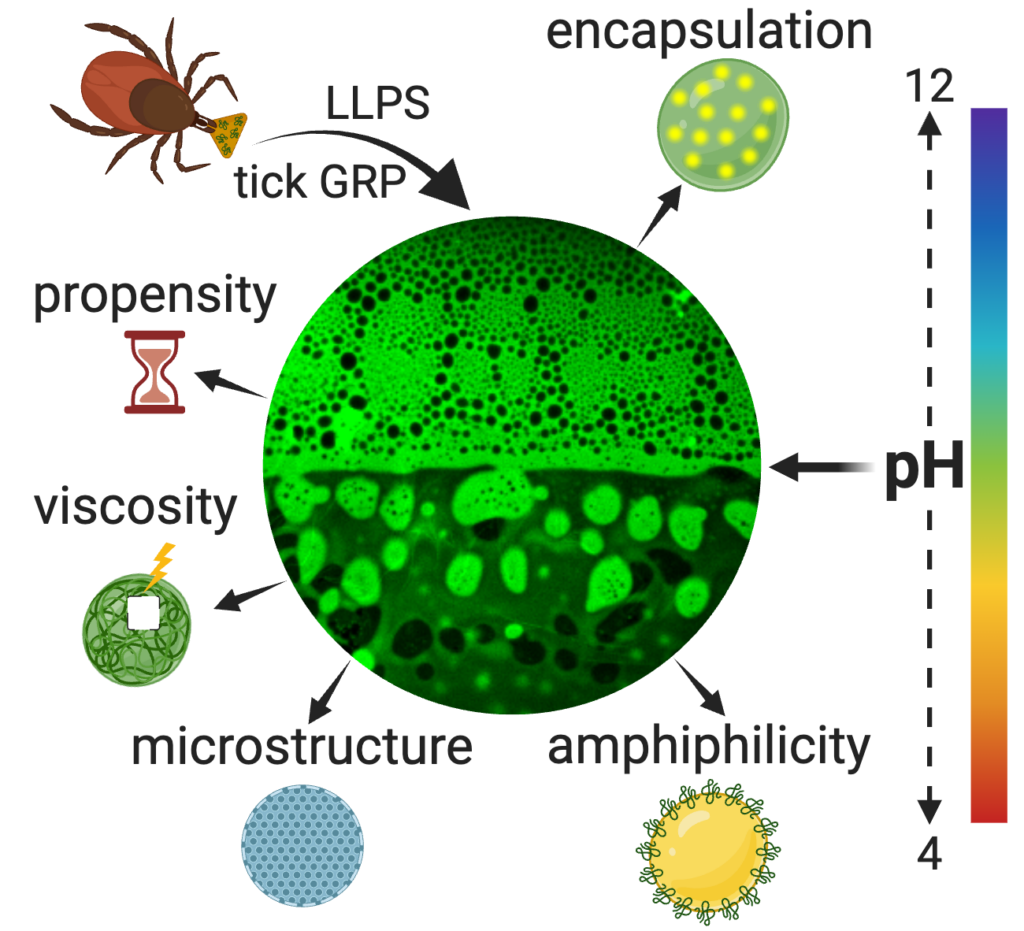
Biomolecular condensates in secretory fluids play a critical role in several organisms: In generating adhesives they serve different purposes such as attachment and prey capture. In their new work, researchers at WUR have focused on hard ticks that secrete a protein-rich saliva which undergoes liquid-to-solid transition forming a strong bioadhesive: The so-called “cement cone” ensures the tick’s firm attachment to its host.
To better understand the underlying molecular mechanisms, the researchers studied a disordered glycine-rich protein from tick saliva that undergoes coacervation in the presence of kosmotropic salts mediated by cation-π and π-π interactions. Over time, the condensates transition from liquid-like to gel-like states.
pH influences the dynamics of coacervation
Although salt concentration, temperature, and molecular crowding are known to influence LLPS, the impact of pH on condensates remains comparatively underexplored. This question is particularly relevant for tick saliva, which likely encounters significant pH changes during a tick bite. Using fluorescence microscopy in droplet evaporation assays, the researchers observed that pH variation directly manifests into differential coacervation dynamics (propensity, progression, appearance of an inverted phase).
Complementary fluorescence recovery experiments and pendent drop tensiometry further showed that pH influences the material properties of the condensates, e.g., viscosity, density, and amphiphilicity. These changes arise from variations in the protonation state and degree of hydrophobicity of the peptide across different pH conditions, highlighting the close interplay between molecular interactions and material behaviour.
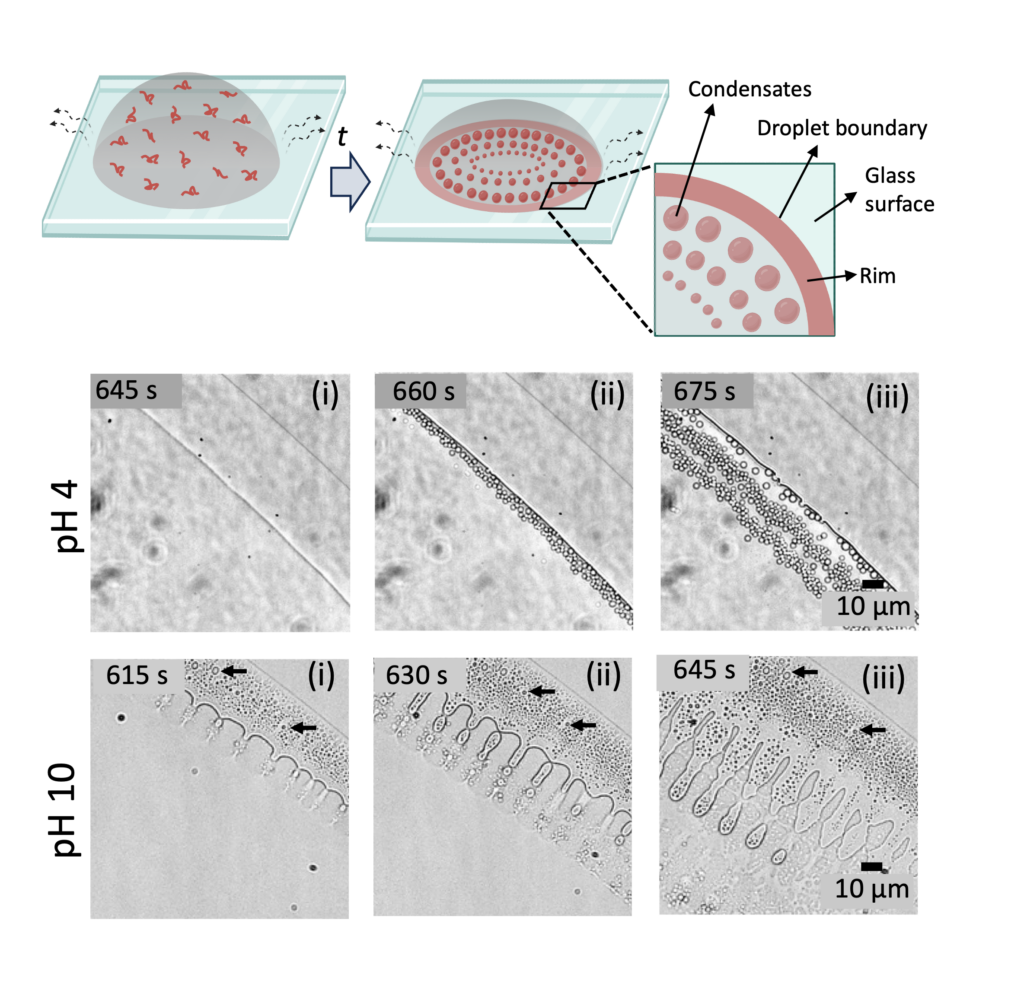
The researchers also explored the encapsulation of curcumin, a hydrophobic therapeutic molecule, and found it to be likewise pH-dependent.
Conclusion
Beyond providing valuable insights into the molecular mechanisms driving pH-dependent phase separation, the findings point toward future applications of biomolecular condensates as tunable drug-delivery vehicles.
Further information
Read more: Nandy. et. al, Adv. Funct. Mater.36, no. 10 /2026): e15418.
SoftComp partner: Wageningen University & Research
Copyright of images: The Authors. Published in Nandy et. al, Advanced Functional Materials (2025) by Wiley-VCH GmbH. This publication is licensed under CC-BY 4.0 .