
Magnetic hyperthermia offers new opportunities for applications ranging from cancer therapy and catalysis control to remotely heating and processing polymer materials, including welding, sintering, microcrack healing and surface smoothing. Beyond previous research on liquids, researchers from SoftComp member UJM-St Etienne and INSA-Lyon, France, now demonstrate that the self-assembly of magnetic nanoparticles within a semi-crystalline polymer can significantly enhance heat generation. By combining infrared thermography with time-resolved synchrotron X-ray scattering, they directly emphasize the coupling between nanoparticle organization and heat generation. Importantly, they show that the orientation of nanoparticle chains relative to the applied magnetic field direction can either enhance or weaken heating efficiency, opening new perspectives for the rational design of magneto-responsive materials.

Report on the 1st webinar of the SoftComp series 2026 – Prof. Dr. Arthi Jayaraman
18 November 2026Report on the 1st webinar of the SoftComp series 2026 – Prof. Dr. Arthi Jayaraman
18 November 2026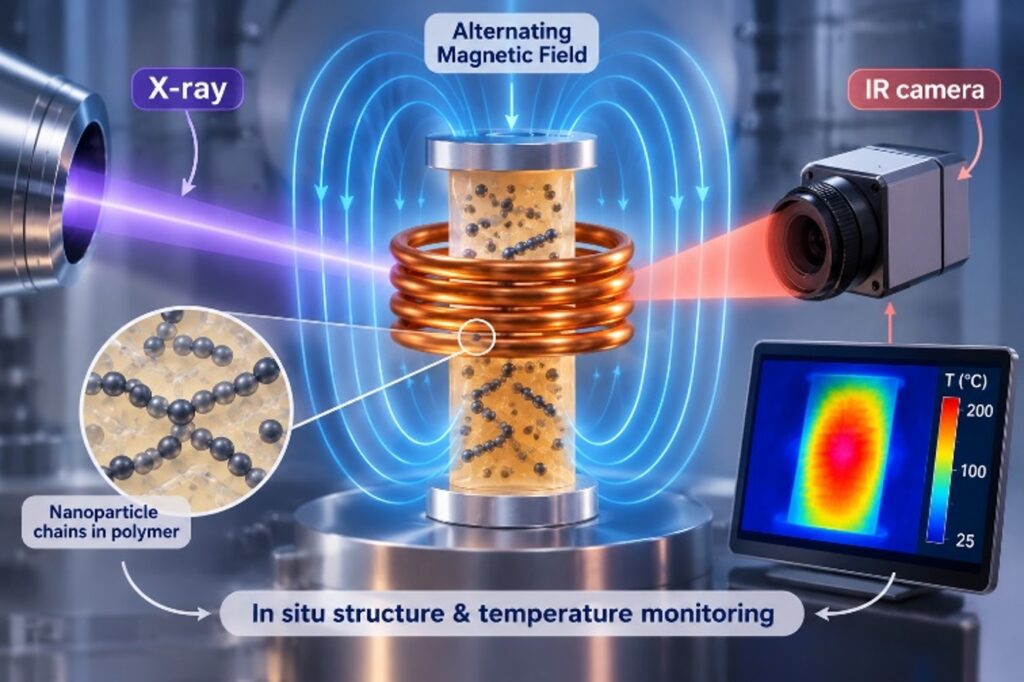
Magnetic hyperthermia relies on the ability of magnetic nanoparticles (MNPs) to dissipate energy when exposed to a high-frequency alternating magnetic field. While particle size, composition and intrinsic magnetic properties are known to govern heating efficiency, the role of nanoparticle organization within polymer matrices remains less understood. In particular, dipolar interactions can drive the formation of chain-like assemblies, potentially modifying magnetic losses and the resulting heat generation.
In this work, researchers investigate this phenomenon using magnetite nanoparticles embedded in a semi-crystalline polypropylene matrix. By combining simultaneous infrared thermography and time-resolved ultra-small-angle X-ray scattering (TR-USAXS) at the European Synchrotron Radiation Facility (ESRF), they establish a direct link between temperature evolution and nanoparticle structural organization under magnetic field irradiation. The polymer melting transition provides a unique opportunity to distinguish between two regimes: below the melting temperature, nanoparticles remain immobilized, whereas above it, their mobility enables field-induced self-assembly.
Significally enhanced heat generation
A key finding is that the formation of dipolar chains significantly enhances heat generation. Following an initial heating cycle, which activates nanoparticle mobility and promotes chain formation, the specific absorption rate increases by roughly 30% from approximately 109 to 142 W per gram of MNPs. This enhanced heating response is maintained during subsequent cycles, demonstrating that the newly formed structures persist and contribute to more efficient energy dissipation.
Importantly, the orientation of these assemblies proves to be equally critical. While chains aligned parallel to the magnetic field promote heating, a perpendicular orientation strongly weakens it, even preventing the polymer from reaching its melting temperature under otherwise identical irradiation conditions. Once melting is triggered with a higher magnetic power, the perpendicular chains progressively reorganize along the magnetic field, restoring efficient heat generation.
Beyond revealing the microscopic mechanisms governing magnetic hyperthermia in polymer nanocomposites, this work demonstrates how controlling nanoparticle assembly provides a powerful route to tune thermal response. Remarkably, temperatures exceeding 200 °C can be quickly achieved under relatively low magnetic field amplitudes (approximately 4 mT), highlighting the potential of structural engineering to advance magnetic-field-assisted polymer processing.
Further information
Read more: Laura Ea, Florent Dalmas, Angelo Pommella, Joël Lachambre, Jérôme Adrien, William Chèvremont, Lise-Marie Lacroix, Gildas Coativy, Guilhem P. Baeza; Nanoparticle Assembly Drives Magnetic Hyperthermia in Semi-Crystalline Polymers. ACS Materials Lett. 7 September 2026; 8 (9): 2640–2646. https://doi.org/10.1021/acsmaterialslett.6c00501
Funding: This research was primarily funded by the French Ministry of Higher Education and Research through a PhD grant and received additional support from the French National Research Agency (ANR) through the JCJC project “MANIOC” (ANR-22-CE06-0006) and the Auvergne-Rhône-Alpes Region through the Ambition Internationale programme.
SoftComp partners: Université Jean Monnet, Saint-Etienne, IMP lab & INSA-Lyon, MATEIS lab