
Even a familiar phenomenon like a bounce can reveal new insights into the properties of soft matter, as a new study by researchers from, among others, the SoftComp partner Durham University, UK, demonstrates. At the same time, the researchers are building a bridge between two physical theories: Wagner’s theory of impact and Hertzian contact theory.
Water’s Hidden Switch: How Ferroelectricity May Trigger Its Mysterious Phase Transitions
17 December 2025
Tiny Defects, Big Consequences: Why Micron-thick Films Tear Before Molecular Forces Matter
22 May 2026Water’s Hidden Switch: How Ferroelectricity May Trigger Its Mysterious Phase Transitions
17 December 2025Tiny Defects, Big Consequences: Why Micron-thick Films Tear Before Molecular Forces Matter
22 May 2026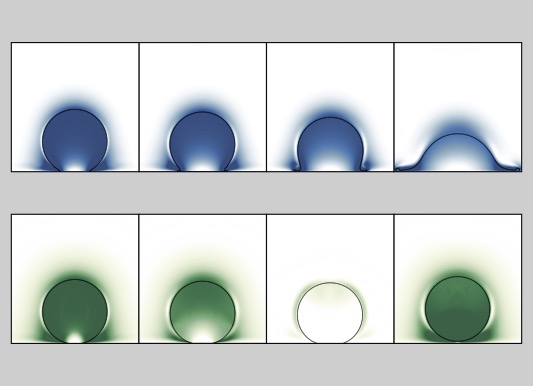
When a liquid drop, e.g. a water drop, hits a water-repellent surface, it first spreads out, then retracts due to surface tension, and often bounces off. By contrast, when an elastic bead strikes the same surface, it stores the impact as deformation and rebounds with minimal spreading. These behaviours have long been described by separate theories: Wagner’s for liquid drops and Hertzian for elastic solids. The intermediate case is the one many soft materials occupy: gels, polymer solutions, and soft biological materials can flow like liquids a while still retaining a kind of “memory” of their original shape. How do such materials behave upon impact?
A recent study by researchers from SoftComp partner Durham University, UK, as well as University of Twente, the Netherlands, EPFL, Switzerland, and Max Planck Institute for Dynamics and Self-Organisation, Germany, proposes a unified framework to answer this question. Using simulations, they examined how a viscoelastic sphere—one that combines fluid-like and solid-like properties—behaves when it impacts a rigid surface. Two key parameters govern the response: the material’s stiffness, which sets how strongly the sphere resists being squashed, and its “memory”, which sets how long a deformation persists before relaxing.
Quantitative predictions possible
The results reveal a continuous spectrum of behaviour: If the material is very soft, or its memory fades quickly, the impact resembles that of a liquid drop. If it is stiff and retains memory, it exhibits the staged force response expected of an elastic solid before rebound. Crucially, the transition between these regimes is smooth, not abrupt.
This matters because the force during impact controls spreading, deformation and rebound. The new framework allows these processes to be predicted quantitatively for materials in the intermediate regime between fluids and solids. This has practical implications, for example, in 3D printing with viscoelastic inks or in the use of hydrogel beads in biomedical applications. At the same time, the work suggests a new perspective: a simple “bounce” can serve as a diagnostic tool. By analysing impact behaviour, it may be possible to infer how strongly a material retains memory of its shape.
Further information
Read more: S. Jana, J. Kolinski, D. Lohse, and V. Sanjay, Soft Matter 22, 2226 (2026). https://doi.org/10.1039/D5SM01078K
SoftComp partner: Durham University