
Thin liquid films often rupture while they are still a few microns thick—far earlier than classical theory predicts. This matters, for example, in the development of spray systems, foams or coatings. The key lies in the unavoidable imperfections of real systems—because perfectly smooth films simply do not exist. Using simulations, researchers from – amongst others – the SoftComp partner Durham University, UK, have established a deterministic failure criterion that takes these imperfections into account.

Impact with Memory: How Soft Materials Bridge Liquids and Elastics
12 May 2026
New Tricks from Ticks: How pH Shapes Biomolecular Condensates
8 June 2026Impact with Memory: How Soft Materials Bridge Liquids and Elastics
12 May 2026New Tricks from Ticks: How pH Shapes Biomolecular Condensates
8 June 2026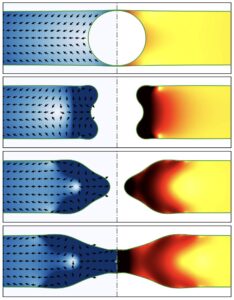
Thin liquid films often rupture while they are still a few microns thick. That is too early for the classical explanation. The molecular van der Waals forces that pull a film apart become important only at nanometre thicknesses, roughly a thousand times thinner than the sheets seen to fail regularly in experiments and applications.
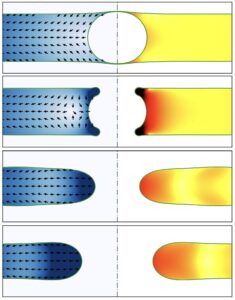
The missing ingredient is imperfection. Perfectly smooth films do not exist in real systems: A draining sheet can contain a tiny, entrained air bubble, dust particle, or oil droplet, and that defect can open a hole long before molecular forces matter. But it does not always do so. Sometimes the same kind of disturbance closes again and the sheet survives.
A test of two conditions
The research team from – amongst others – University of Twente, the Netherlands, City College of New York, USA, Sorbonne University, France, Durham University, UK, showed this by simulating a draining liquid sheet pierced by a single air bubble. The bubble becomes a test of two conditions. First, the surrounding flow must pull hard enough to overcome surface tension, which tries to round the cavity and seal it. Second, the cavity must already be deformed far enough that its rim retracts outward rather than collapsing back in. Both conditions are needed. If either one is missed, the sheet heals; if both are crossed, the hole grows irreversibly.
The result is a deterministic rupture criterion. The fate of the sheet is set by the local drainage flow and by the geometry of the defect, without appealing to molecular rupture at unrealistically small thicknesses. That matters for spray technologies, where rupture controls droplet size, and for respiratory flows, where bursting films can generate aerosols. It also gives a design rule for foams and coatings, where the aim is the opposite: keep the film intact.
Further information
Read more: A. K. Dixit, C. Zhao, S. Zaleski, D. Lohse, and V. Sanjay, Phys. Rev. Lett. 136, 084001 (2026). DOI: 10.1103/bdpw-7mr5; arXiv (OA): https://arxiv.org/abs/2509.12789
SoftComp partner: Durham University