
Humins are a by-product of biomass processing that are typically regarded as low-value waste. Researchers at SoftComp partner KU Leuven in The Netherlands now demonstrate that these furan-rich materials can directly serve as building blocks for dynamic covalent polymer networks. This opens new opportunities for sustainable materials design. Furthermore, the scientists reveal an unusual thermo-mechanical response. Previous work of the same group published by SoftComp had demonstrated how chemical modification can transform humins into processable building blocks for polymer blends.

SoftComp/EUSMI Annual Meeting 2026 in Zakopane with more than 100 attendees
15 June 2026
Updated SoftComp Research Roadmap now available
17 July 2026SoftComp/EUSMI Annual Meeting 2026 in Zakopane with more than 100 attendees
15 June 2026Updated SoftComp Research Roadmap now available
17 July 2026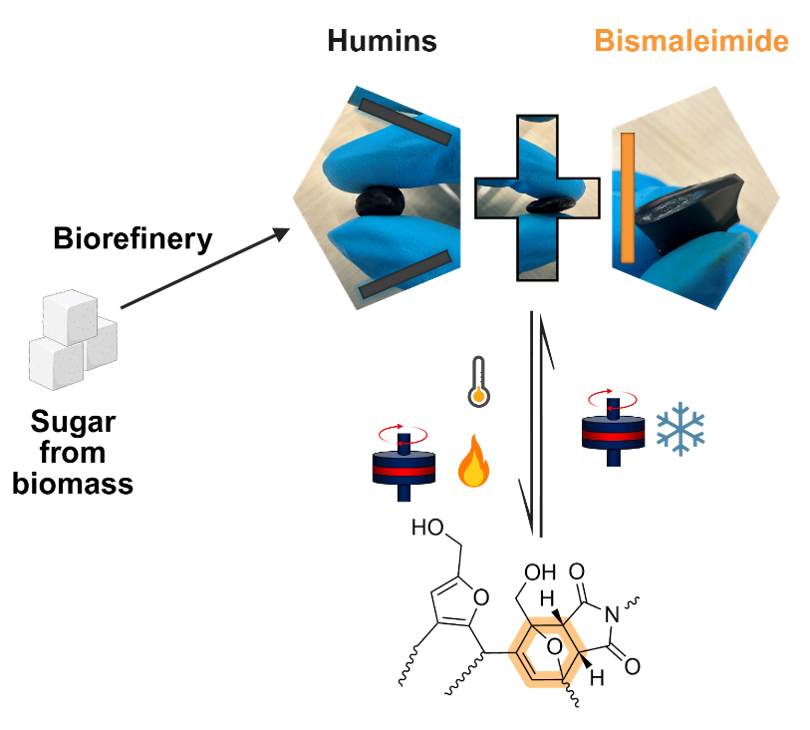
In recent years, there has been an increasing interest in valorising biorefinery side streams into functional materials. Among these, humins – furan-rich by-products formed during sugar processing – remain largely underexplored despite their intrinsic chemical functionality. Their heterogeneous and macromolecular nature has traditionally limited their use in controlled chemical transformations.
Researchers in the Soft Matter, Rheology and Technology Group at KU Leuven, have now shown that industrial humins can be directly utilized as a renewable diene source in Diels–Alder (DA) chemistry. The Da reaction has already been established in selected industrial syntheses, including vitamin B6 production and cyclopentadiene/dicyclopentadiene chemistry. Without purification or fractionation, humins react with bismaleimides under mild conditions to form dynamic covalent networks. The reaction proceeds predominantly via an endo-selective pathway despite the chemical complexity of the humin matrix.
The resulting materials exhibit tuneable mechanical, thermal, and electrical properties. Because the DA bonds remain reversible, the materials can be reprocessed and display self-healing behaviour. This demonstrates the significant potential of dynamic covalent chemistry for extending material lifetimes.
Unconventional thermo-mechanical response
A key finding of this work is the emergence of an unconventional thermo-mechanical response. Under oscillatory shear, the DA equilibrium is not governed by temperature alone: forward cycloaddition is favoured at elevated temperatures, while retro-DA is promoted upon cooling. This inverted behaviour highlights a cooperative interplay between mechanical deformation and chemical reactivity, in which oscillatory conditions actively promote bond formation and network evolution.
Importantly, the approach proved robust across multiple batches with substantially different viscosities and compositions. This suggests a realistic pathway towards sustainable material design from low-value biomass residues.
Further information
Read more: Kandemir et al., Green Chem., 2026,
DOI: 10.1039/d6gc00070c
SoftComp partner: KU Leuven – Soft Matter, Rheology and Technology (SMaRT)