
A general Principle using Segregative Phase Separation
The formation and regulation of biomolecular condensates is central to many cellular processes and remains a key challenge in the construction of synthetic cells. Researchers from SoftComp partner Wageningen University & Research in the Netherlands and the University of California, Davis in the USA reveal how segregative phase separation (SPS) can be used to precisely regulate associative phase separation (APS) inside cell-like environments. Their findings provide a mechanistic framework for controlling condensate localisation and membrane interactions in synthetic cells, offering new routes to designing structured, multi-phase reaction environments.
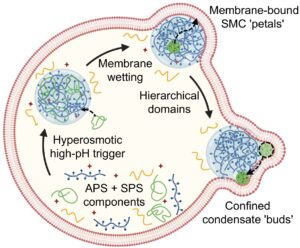
In crowded biological systems, macromolecules naturally self-organize into distinct microenvironments. To investigate this phenomenon, the researchers used a combination of synthetic polymers and biomolecules to recreate phase-separated systems inside liposomes and double emulsions. They found that dextran-rich domains generated through SPS acted as molecular recruiters, selectively attracting biomolecules such as poly-L-lysine and confining them within localized regions. These regions then served as nucleation sites for biomolecular condensates, directing where and how coacervates formed.
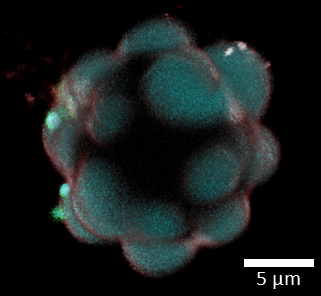
Further experiments revealed that these SPS-generated microdomains not only controlled the spatial positioning of condensates but also restricted their movement, effectively creating isolated “hubs”. At the same time, these microdomains interacted with lipid membranes, forming bud-like, flower-shaped structures that resembled organelle organization in living cells. This membrane interaction enabled condensates to be transported and anchored to specific locations, introducing a new level of spatial regulation in synthetic systems.
The findings demonstrate that SPS can function as a powerful tool for the temporal and spatial control of artificial membrane-less organelles. By uncovering a general physicochemical principle governing condensate localization and behaviour, the study opens new possibilities for constructing advanced synthetic cells, developing compartmentalized biochemical reaction systems, and designing novel biomimetic materials.
Read more: Chen C. et. al, ACS Nano (2025)
SoftComp partner: Wageningen University & Research
Images copyright: The Authors. Published in Chen C. et. al, ACS Nano (2025) by the American Chemical Society. This publication is licensed under CC-BY 4.0 .